
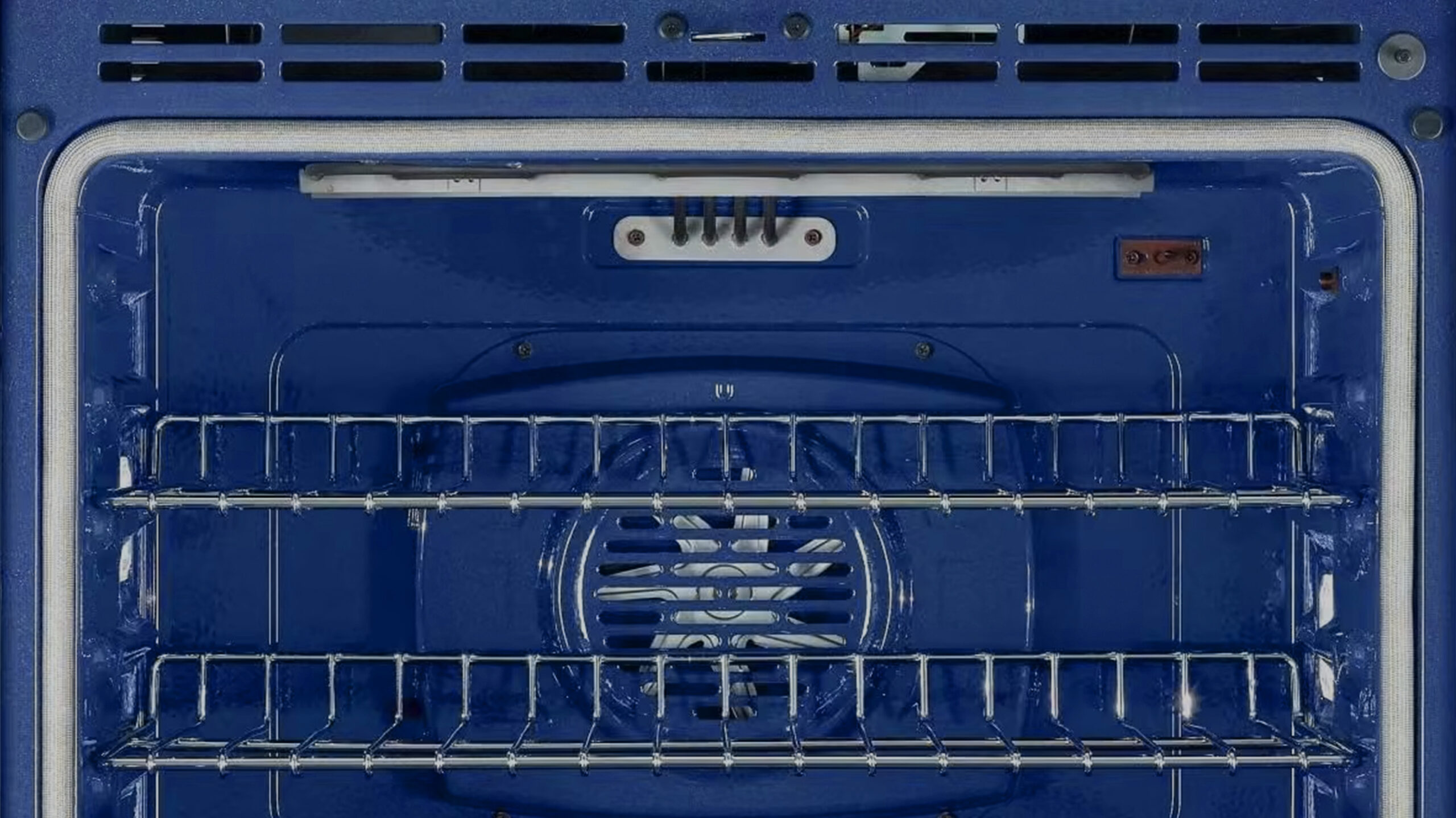
If you have shopped for a new range or wall oven, you already know convection is the feature everyone talks about. It promises more even cooking, faster bake times, and the freedom to fill every rack without rotating pans halfway through. That much is true. What most shoppers do not realize is that “convection” is not one single technology. Depending on the brand and the model, it can mean very different things happening inside your oven.
Some ovens simply recirculate leftover heat from the regular bake and broil elements with a single fan. Others generate dedicated heat right at the fan itself. Some push air in from the back wall, and some pull it in from the corners. The word on the spec sheet is the same, but the cooking experience is not. Here is what is actually going on behind each type, so you can shop with a clearer picture of what you are getting.
Every convection system starts from the same basic idea: instead of letting hot air sit still around your food, a fan keeps it moving. That circulation strips away the thin layer of cooler air that naturally clings to a dish, so heat transfers faster and more evenly across the whole surface.
In practical terms, that means faster cook times, more consistent browning from edge to edge, and the ability to bake on two or three racks at once with results that actually match each other. It is the difference between pulling a tray of cookies out with half of them golden and half of them pale, and pulling out a full batch that all look ready at the same time.
That part holds true across every convection oven on the market. Where things start to diverge is how each system creates and moves that air, and that is where the real differences in performance show up.
It is also where a lot of shoppers get tripped up. A spec sheet that says “convection” does not tell you whether that oven has a dedicated heating element built for the job, or whether it is simply reusing heat that was already there. Both will technically qualify as convection. Only one of them is built to deliver on the promise every time.
True European convection, often just called true convection, is one of the most respected systems on the market, and for good reason. Instead of blowing around heat that was already produced by the bake or broil elements, true convection has its own dedicated third heating element wrapped directly around the rear fan. Heat is generated right where the air gets circulated, not borrowed from somewhere else in the cavity.
Bosch, Thermador, and Miele all build their convection modes around this approach, and it shows in day-to-day baking. Because the heat source and the fan work together as one system, temperatures stay steady and predictable from the back of the oven to the front. That consistency matters most when you are baking delicate, individual items, like cookies, pastries, or a tray of dinner rolls, across multiple racks at the same time.
For a household that bakes often, or that regularly cooks for a crowd and needs every rack pulling its weight, true convection is the system built specifically for that job. It is not just moving hot air around. It is producing the right heat, in the right place, on purpose.
That kind of precision also tends to matter most for the recipes that leave the least room for error. Delicate pastry, meringue, or a multi-tray batch of holiday cookies will show you the difference between a good oven and a great one faster than almost anything else you cook.
Wolf takes a different route with its dual VertiFlow technology, and it is worth understanding because it solves a different problem than true convection does. Rather than relying on one central fan at the back wall, Wolf places two vertical fans in the rear corners of the oven, with heating elements running alongside each one.
Because air enters from both sides instead of from a single point in the center, it fills the entire cavity more completely, top to bottom and side to side. That wider, more thorough airflow is exactly why Wolf’s dual VertiFlow ovens can cook on every rack simultaneously with consistent results and far less need to rotate pans partway through cooking. If you have ever had to swap a sheet pan from the top rack to the bottom halfway through baking just to get even color, this is the kind of system designed to make that step unnecessary.
For a busy kitchen cooking multiple dishes for a big family dinner or holiday gathering, that full-cavity coverage can be a real, everyday advantage. Instead of planning your cook times around which rack is closest to the heat source, you can load the oven the way that actually makes sense for your meal and trust that every dish will finish the way it should.
The simplest and most common form of convection is basic fan-assisted convection, sometimes labeled fan bake or simply convection on a spec sheet. This system uses a fan, but it is not paired with its own dedicated heating element. Instead, it circulates the same heat already being produced by the oven’s regular bake and broil elements.
You will find this style on many gas ranges and on lower to mid-range electric ovens. It does improve evenness compared to a standard oven with no fan at all, and for everyday cooking like roasting a chicken or baking a casserole, that improvement is genuinely noticeable. What it will not do is match the precision and consistency of a system that generates heat specifically to feed the fan, the way true convection or dual VertiFlow does. Think of it as a helpful upgrade over standard baking, rather than a replacement for a dedicated convection system.
There is nothing wrong with fan-assisted convection for the way a lot of households cook day to day. The key is knowing that this is what you are getting, so you are not expecting bakery-level, multi-rack precision from a system that was never designed to deliver it.
The right answer depends on how you actually cook.
If baking is a regular part of your routine, whether that is weekly cookies, holiday pastries, or dinner rolls for a full table, true European convection from a brand like Bosch, Thermador, or Miele gives you the steady, dedicated heat that precise baking rewards.
If your kitchen regularly juggles multiple dishes at once, especially around holidays or big family meals, Wolf’s dual VertiFlow gives you that full-cavity, edge-to-edge airflow so every rack performs like the others, without the extra step of rotating pans.
If you are simply looking for a meaningful step up from a standard oven, without needing showroom-level precision on every single rack, basic fan-assisted convection on a well-built range will still noticeably improve your everyday results.
Budget matters here too, and it is worth saying plainly: fan-assisted convection is not a lesser choice; it is simply a different tier of technology, and it is often the right one for a household that bakes occasionally rather than constantly. True convection and dual VertiFlow carry a premium because they are solving a harder problem, generating dedicated heat and distributing it across the entire cavity on purpose. That premium is easiest to justify when you know it will actually get used.
Whichever direction fits your household, it is worth asking exactly what kind of convection a range or wall oven uses before you buy. The word on the spec sheet only tells part of the story.
Curious about how true convection, dual VertiFlow, or fan-assisted baking would actually perform in your own kitchen? At Atherton Appliance & Kitchens, we showcase Bosch, Thermador, Miele, and Wolf ovens in live kitchen settings, so you can see and compare the differences firsthand instead of guessing from a spec sheet.
Stop by our showroom or schedule a consultation to explore your options, compare brands side by side, and see which convection system is the right fit for the way you actually cook.
Watch our video: The Truth About Convection
Atherton Appliance & Kitchens: Where design, performance, and everyday life come together.